Craig Ryan
How to Flirt with A Naked WerewolfCraig Ryan is a missing nineteen-year-old hiker whose disappearance, together with that of Jacob Bennett, exposes the scale and apparent organization of the wolf violence threatening Grundy. His role is brief but consequential: he begins as a young tourist associated with reckless adventure, becomes the subject of a town-wide search and desperate appeals, and ends as a name attached to bones scattered through a ravine. Through Craig, the narrative shifts from isolated assault to an expanding crisis involving tourists, wildlife officials, local volunteers, and the hidden violence of the wolf world.
Identity and Introduction
Craig Ryan is identified as one of two students from ASU who visited the Blue Glacier Saloon shortly before the big weather arrived. The pair had attempted to use fake identification to buy beer and planned to climb into the Evanston Game Reserve to play what the townspeople describe as Survivor Man. Their youth is emphasized when their parents later arrive with missing-person flyers: Craig and Jacob are nineteen, still marked by the confidence of adolescence, with braces-perfect teeth and acne visible in their photographs. The contrast between their ordinary, almost carefree appearance and the fate awaiting them gives their disappearance its particular pathos.
Craig is not characterized through extended speech, private history, or direct action. Instead, the town knows him through fragments: a tourist passing briefly through the saloon, a face Mo cannot recall among the many visitors, and a son whose parents demand information after he fails to check in. This limited identity is itself significant. Craig is initially absorbed into the anonymous flow of outsiders moving through Grundy, but his disappearance forces the community to recognize the individual cost hidden behind that category.
Disappearance and Search
Craig and Jacob were expected to contact friends after their trip, but no one had heard from them for three days. The state police notified the town, and Buzz, Alan, and other local men joined the search. Mo learns of the disappearance while the community is already unsettled by the attack on Susie Q, so the missing hikers do not seem like an unrelated accident. The timing links their absence to the broader pattern of animal violence and makes the wilderness feel less like a recreational landscape than an active threat.
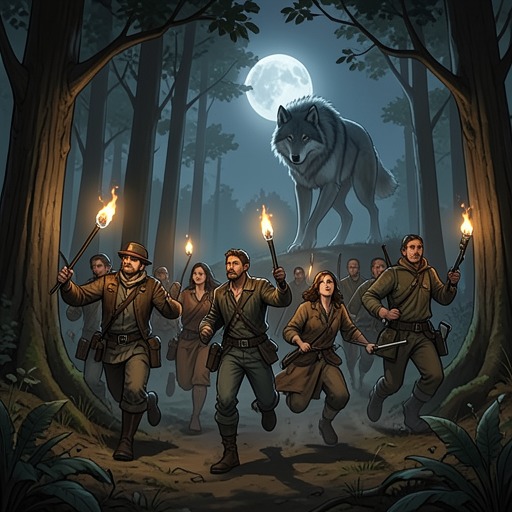
The search site contains extensive blood smears but no bodies or recognizable remains. Alan reports that it appeared the hikers had fought back and been dragged away from the campsite, kicking and screaming. They had rifles, which makes the outcome more disturbing: two armed adult men were apparently surprised and overwhelmed. The evidence also suggests multiple attackers, because a normal wolf pack would generally avoid humans when escape was possible. Alan describes the attack as organized, as though the wolf knew how to enter, obtain what it wanted, and leave without being injured. Craig’s disappearance therefore becomes evidence not merely of danger, but of intelligence, coordination, and an unknown motive.
The first search party returns empty-handed. The failure intensifies the families’ distress and leaves the town with uncertainty rather than closure. The parents bring stacks of neon-yellow flyers reading, “Have You Seen These Boys?” to the Blue Glacier Saloon, where Evie and Buzz agree to display them. Craig’s mother presses Buzz for details about the boys’ visit and asks whether they seemed all right. Her questions expose the gap between the town’s practical knowledge and a parent’s need to reconstruct the final ordinary moments of a child’s life.
Discovery of the Remains
The remains are found only after the snow clears. Alan locates Craig and Jacob roughly a mile from their campsite, in a ravine, where their bones lie scattered. The bodies have been gnawed by many different animals, leaving no comforting completeness and making the discovery more gruesome than a simple recovery. Alan remains at the scene until the remains can be taken somewhere decent, while Buzz contacts the state medical examiner’s office and heads up the mountain.
The discovery supplies physical confirmation but not an explanation. Mo already believes there is little chance that Craig and Jacob are alive, yet finding their remains makes the loss final in a way that an empty search could not. It also renews the central questions: what attacked them, whether the attack will be repeated, and whether the scattered bones represent the work of ordinary animals after death or the aftermath of a deliberate wolf assault. Craig’s death thus resolves the question of survival while preserving the mystery at the heart of the novel.
Relation to the Wider Violence
Craig’s fate forms a grim progression with the other attacks around Grundy. John Teague’s assault on Mo is a human crime linked to robbery and repeated attacks on women; Susie Q’s injuries reveal an animal attack on a surviving resident; Craig and Jacob’s disappearance suggests a coordinated assault on outsiders in the wilderness; and Abner’s later mauling brings the violence directly into the town’s circle of familiar people. The sequence enlarges both the danger and the community’s sense of responsibility.
The official response also throws the town’s informal protective network into relief. In Mo’s earlier assault, Trooper Brent tells her to be more careful and avoid dark alleys, shifting attention toward the victim’s behavior even after learning that the attacker had targeted waitresses and had put other women in intensive care. By contrast, Craig’s disappearance prompts volunteers, state police, wildlife personnel, and local searchers to mobilize. The difference reflects the social complexity of danger in Grundy: vulnerability is treated differently depending on whether the victim is a working woman, an injured local, or a pair of young outsiders whose parents arrive to demand answers.
Craig’s death also deepens the uncertainty surrounding Cooper and the wolves. When Mo later finds Abner badly mauled, Cooper fears that he may have transformed during the night and attacked him, because he cannot remember the night and Abner reacted to the black wolf with terror. The earlier disappearance of Craig and Jacob has already established that wolf violence may be organized, yet the narrative refuses to make every attack immediately attributable to the same wolf. Craig’s case remains part of the larger pattern without becoming simple proof against a single individual.
Narrative Significance
Craig functions as an absent character whose story is constructed through public traces: a failed check-in, a search party, neon-yellow flyers, a ravine, and scattered bones. His absence changes the emotional geography of Grundy. Tourists are no longer merely passing customers in the saloon, and the surrounding preserve is no longer simply a place for an ill-advised adventure. The wilderness has become connected to grief, evidence, and the possibility of further attacks.
The treatment of Craig and Jacob also emphasizes the novel’s recurring contrast between visible evidence and concealed truth. Blood, footprints, rifles, and bones establish that something violent occurred, but they do not explain the attackers’ identity, motives, or relationship to the town. That withholding keeps Craig’s death active in the plot even after his remains are found. He is not only a victim whose story ends in the ravine; he is one of the facts that makes the hidden conflict impossible to dismiss as rumor, accident, or a single frightened animal’s aberrant behavior.